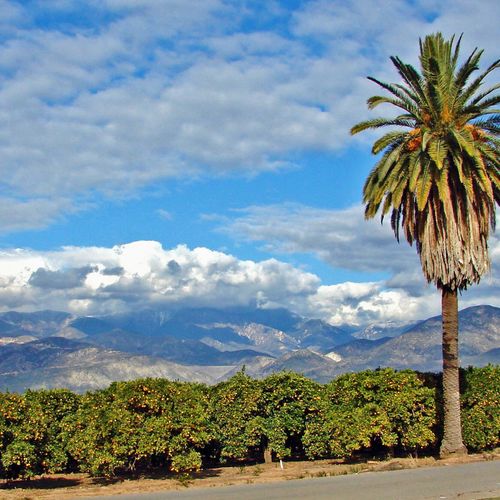

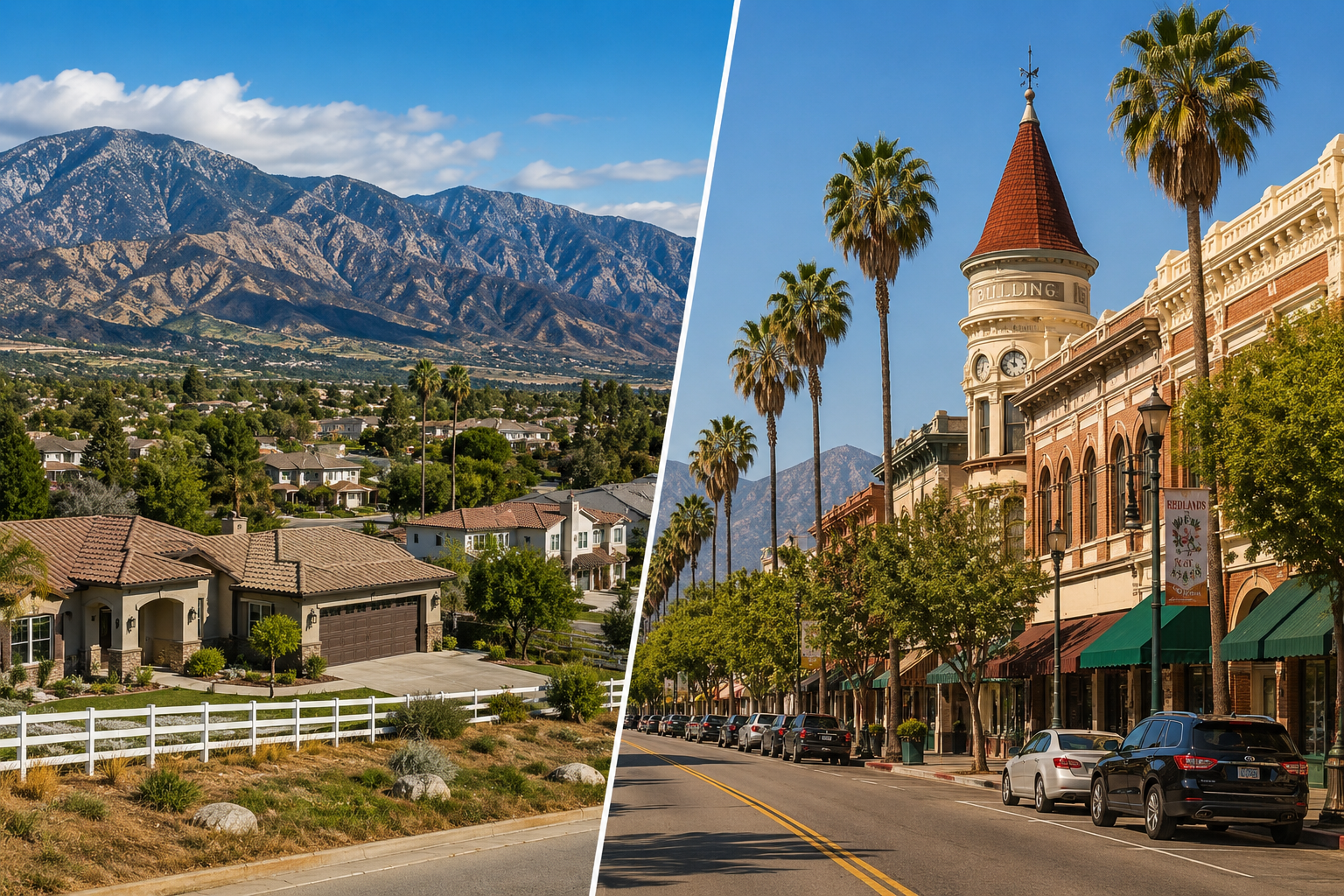
If you're looking for a home in the eastern Inland Empire, there's a good chance Yucaipa and Redlands will both end up on your list.
They're neighboring communities in San Bernardino County, they're both positioned against the San Bernardino Mountain foothills, and both have deep agricultural roots. Yet actually living in Yucaipa and living in Redlands can feel surprisingly different.
Redlands offers a historic downtown, mature neighborhoods, distinctive architecture, restaurants, cultural institutions and a more established urban core.
Yucaipa generally feels more spread out and foothill-oriented, with newer communities, larger-property opportunities, open-space access and Historic Uptown serving as a smaller community center.
Neither city is automatically the better place to buy.
The better question is:
Which one fits the type of home and lifestyle you're actually looking for?
Here's how Yucaipa and Redlands compare.
Yucaipa vs. Redlands at a Glance
For buyers trying to make a quick distinction:
Choose Yucaipa if you're prioritizing: foothill living, more suburban or semi-rural surroundings, newer planned communities, potential for larger lots, outdoor recreation and a quieter small-city environment.
Choose Redlands if you're prioritizing: historic neighborhoods, a walkable downtown, restaurants and shopping, architectural character, cultural amenities and a wider variety of established neighborhoods.
That's an oversimplification—both cities offer considerably more—but it's a useful starting point.
What Is Living in Yucaipa Like?
Yucaipa sits farther east and higher into the foothills than much of the surrounding San Bernardino Valley.
The city itself emphasizes its setting against the San Bernardino Mountains and its distinctive topography as major parts of Yucaipa's identity. Yucaipa incorporated in 1989 after decades of transitioning from agricultural land into residential development.
That history is still visible in the city's housing.
You can find conventional suburban neighborhoods, newer planned developments, older ranch-style properties and areas where larger lots and a more open feeling remain.
Communities such as Chapman Heights, Hidden Meadows, Whisper Ranch and North Bench each provide a noticeably different version of Yucaipa living.
Historic Uptown Yucaipa has also become an increasingly important community gathering area, and the city's General Plan specifically identifies Uptown revitalization as part of Yucaipa's modern development.
But Yucaipa isn't primarily a downtown-oriented city.
Its biggest lifestyle advantage may be the combination of residential neighborhoods and proximity to the outdoors.
What Is Living in Redlands Like?
Redlands has a different personality.
Founded in 1881 and incorporated in 1888, Redlands developed around the citrus industry and eventually became known for its impressive homes, civic buildings and tree-lined neighborhoods.
That history remains unusually visible today.
Downtown Redlands includes State Street, Orange Street, historic commercial buildings, locally owned businesses and restaurants, while nearby neighborhoods contain Craftsman bungalows, Victorian homes and other architecture dating back generations.
Landmarks including the A.K. Smiley Public Library, Redlands Bowl and Prospect Park contribute to a sense of place that is difficult to reproduce in newer Southern California communities.
Redlands therefore tends to appeal to buyers who want their neighborhood and surrounding city to have more established architecture, activity and history.
Homes in Yucaipa vs. Redlands
This is where the comparison gets particularly interesting for homebuyers.
Yucaipa Homes
Yucaipa's housing inventory spans several different eras.
Buyers can encounter older ranch homes, conventional tract neighborhoods, larger custom properties and newer planned communities.
Chapman Heights, for example, represents a much newer style of residential development than many of the established neighborhoods closer to central Yucaipa.
Areas such as North Bench and Hidden Meadows can offer a different experience again, particularly for buyers prioritizing foothill settings, views or larger properties.
This variety means someone saying, "I want to live in Yucaipa," still hasn't narrowed the search very much.
The neighborhood matters.
Redlands Homes
Redlands also offers significant variety, but its older housing stock gives buyers options that are much harder to replicate elsewhere in the Inland Empire.
The City specifically identifies its housing mix as including Craftsman bungalows, Victorian homes, contemporary executive homes and modern neighborhoods.
Some buyers specifically come to Redlands because they want that character.
The tradeoff is that an older house can bring different ownership considerations than a newer home—electrical systems, plumbing, foundations, roofing, renovations and historical-property considerations all deserve appropriate due diligence.
A beautifully restored Redlands home and a newer Yucaipa home may be similarly attractive for completely different reasons.
Which Has Larger Lots?
If land is high on the wish list, Yucaipa deserves serious attention.
Yucaipa's development history included small farms and agricultural parcels. In 1910, the Redlands & Yucaipa Land Company acquired approximately 11,000 acres with plans for a town surrounded by farms ranging from roughly 5 to 20 acres.
Most modern Yucaipa homes obviously aren't sitting on five-acre farms, but that history helps explain the city's development pattern and why buyers can still encounter areas with larger residential parcels.
Redlands certainly has larger properties too, particularly in some of its more prestigious or less densely developed neighborhoods.
But if a buyer tells Nick Ondatje that acreage, RV space, additional structures or simply more separation from neighboring homes is a major priority, expanding the search into the right parts of Yucaipa can uncover options that look very different from a typical Redlands neighborhood.
Downtown Redlands vs. Uptown Yucaipa
This is one category where the cities really aren't equivalent.
Downtown Redlands is the larger and more established destination.
State Street and the surrounding downtown area contain restaurants, boutiques, historic buildings and public spaces. The city's official historic walking tour specifically follows Orange and State streets through commercial buildings, some more than a century old.
Yucaipa has Historic Uptown, centered around California Street and the surrounding area.
The Yucaipa Performing Arts Center is also located there, adding entertainment and community programming to the district.
Uptown gives Yucaipa a recognizable center, but buyers expecting something comparable in scale to Downtown Redlands should understand the difference.
If walking to restaurants, coffee, shops and historic architecture is central to your ideal lifestyle, Redlands has the advantage.
If you prefer being farther from a busy downtown environment, that same difference may push you toward Yucaipa.
Outdoor Recreation: Yucaipa vs. Redlands
Both communities benefit from their foothill locations, but Yucaipa arguably makes outdoor access a bigger part of its overall identity.
Yucaipa is surrounded by open space and sits near Wildwood Canyon State Park, Crafton Hills and Yucaipa Regional Park.
Wildwood Canyon's landscape preserves a portion of the area's ranching and agricultural history while providing access to foothill terrain.
Redlands isn't exactly lacking green space, though.
The city maintains an extensive park and trail network, including Prospect Park, Ford Park, Caroline Park and numerous neighborhood parks. The city reports 18 established parks encompassing more than 253 acres.
Caroline Park alone provides native landscaping, trails and a dramatic overlook toward the surrounding mountains.
The difference is more about atmosphere.
Yucaipa feels closer to the transition between suburb and foothill country.
Redlands feels more like an established city with substantial parks and open space woven into it.
Restaurants, Shopping and Things to Do
Redlands wins on sheer concentration.
Downtown provides restaurants, independent shops and historic attractions in a relatively compact area. The city actively promotes Downtown Redlands for its dining, shopping, architecture and cultural attractions.
There's also the Redlands Bowl, University of Redlands, museums, historic sites and community events.
Yucaipa has its own restaurants, local businesses, Performing Arts Center and community events, but they're distributed across a smaller city center and broader commercial corridors.
Yucaipa also has something Redlands doesn't: extremely convenient access toward Oak Glen.
For someone who regularly wants orchards, foothills, seasonal events and mountain drives nearby, that's meaningful.
Commuting and Location
Where you work may make this decision easier.
Redlands has direct access to I-10 and SR-210, and it also has passenger rail service through the Arrow/Metrolink system.
That gives Redlands a transportation advantage for some commuters.
Yucaipa is farther east, with I-10 access primarily through the southern portion of the city and nearby Calimesa.
For someone commuting west every day toward San Bernardino, Riverside, Ontario or Los Angeles County, even relatively small differences in location can become meaningful over hundreds of trips per year.
On the other hand, someone working remotely or prioritizing the foothill lifestyle may care far less about being farther east.
Don't compare the cities on a map alone.
Test the commute from the actual neighborhood you're considering.
Yucaipa vs. Redlands for Historic Homes
Redlands.
This one isn't particularly close.
Redlands has an unusually strong concentration of historically significant architecture for an Inland Empire city.
The areas around Smiley Park, Olive Avenue, Highland Avenue and Prospect Park include turn-of-the-century homes and some of the city's best-known residential architecture.
Yucaipa has historic properties and a rich local history of its own, but its identity isn't built around Victorian and Craftsman neighborhoods in the same way.
If your Zillow favorites folder is full of original hardwood floors, built-ins, porches and century-old houses, start in Redlands.
If your favorites folder is full of three-car garages, foothill views and larger lots, Yucaipa may start winning pretty quickly.
Yucaipa vs. Redlands for Newer Homes
Here the advantage generally shifts toward Yucaipa.
Yucaipa experienced substantial residential development as former agricultural land transitioned into housing, including the development of Chapman Heights beginning in the late 20th century.
That gives buyers opportunities for homes and communities that feel distinctly newer than Redlands' historic core.
Redlands has newer housing as well, so this isn't an absolute rule.
But buyers specifically seeking a modern suburban home should compare Yucaipa carefully before making a decision.
Which City Is Better for Home Buyers?
There isn't a universal winner.
A buyer who wants a historic Craftsman near restaurants and Downtown Redlands shouldn't be persuaded into Yucaipa simply because another house has more square footage.
Likewise, someone who wants a larger property, foothill views and a quieter residential setting shouldn't automatically pay for proximity to Downtown Redlands if they rarely intend to use it.
This is where comparing the two markets property-by-property becomes valuable.
When Nick Ondatje works with buyers considering Yucaipa and Redlands, the useful comparison isn't simply price versus price. It's what the same budget actually buys in each community—and which compromises come with each property.
Sometimes the answer is clearly Redlands.
Sometimes it's clearly Yucaipa.
And sometimes buyers don't know which they prefer until they've driven through both.
Yucaipa vs. Redlands: Quick Comparison
| Priority | Yucaipa | Redlands |
|---|---|---|
| Historic architecture | Some | Strong |
| Established downtown | Smaller Uptown | Strong |
| Newer communities | Strong | Available |
| Larger-lot opportunities | Strong | Available |
| Foothill atmosphere | Strong | Strong |
| Restaurants & shopping | Growing | Strong |
| Historic neighborhoods | Some | Strong |
| Outdoor access | Strong | Strong |
| Passenger rail | No | Yes |
| Small-town/less urban feel | Strong | Moderate |
These are broad community-level comparisons. Individual neighborhoods and properties can differ substantially.
Frequently Asked Questions
Is Yucaipa cheaper than Redlands?
It can be, but buyers shouldn't assume it automatically. Prices vary by neighborhood, home size, lot, age and condition, and market conditions change constantly. The better comparison is what your specific budget can buy in each city at the time you're searching.
How far is Yucaipa from Redlands?
The cities are neighbors in the eastern San Bernardino Valley, although drive time depends heavily on which parts of each city you're comparing.
Does Yucaipa have a downtown?
Yucaipa has Historic Uptown, centered around the California Street area. It serves as a community and entertainment district, but it is smaller than Downtown Redlands.
Which has more historic homes, Yucaipa or Redlands?
Redlands. Its established neighborhoods contain significant concentrations of Craftsman, Victorian and other historic architecture.
Which is better for larger lots?
Yucaipa is worth prioritizing if lot size is important, particularly in its less densely developed areas. However, both cities contain larger properties.
Which is better for hiking and outdoor recreation?
Both offer excellent access to outdoor recreation. Yucaipa has particularly convenient access to foothill environments around Wildwood Canyon and Crafton Hills, while Redlands maintains an extensive network of parks, trails and open space.
Is Redlands better for commuting?
For some commuters, yes. Redlands has I-10 and SR-210 access plus passenger rail service, which can make it more convenient depending on the destination.
So, Yucaipa or Redlands?
Think about the choice this way:
Yucaipa: foothills, space, newer communities, larger-property opportunities and a quieter residential environment.
Redlands: history, architecture, Downtown, restaurants, culture and established neighborhoods.
They're close enough geographically that homebuyers don't necessarily need to choose one before beginning their search.
In fact, seeing both is often the best way to understand the difference.
For buyers considering Yucaipa, Redlands or surrounding Inland Empire communities, Nick Ondatje can help compare current homes, neighborhoods and what your budget buys on each side of the Crafton Hills.
Nick Ondatje | REALTOR®
Mainstreet Realtors
CA DRE 01401990
909-437-0132
Check out this article next