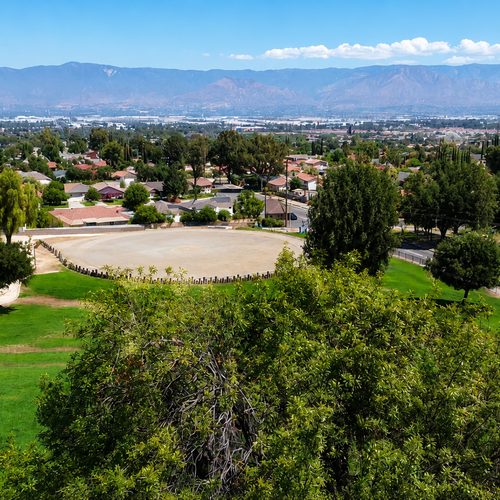

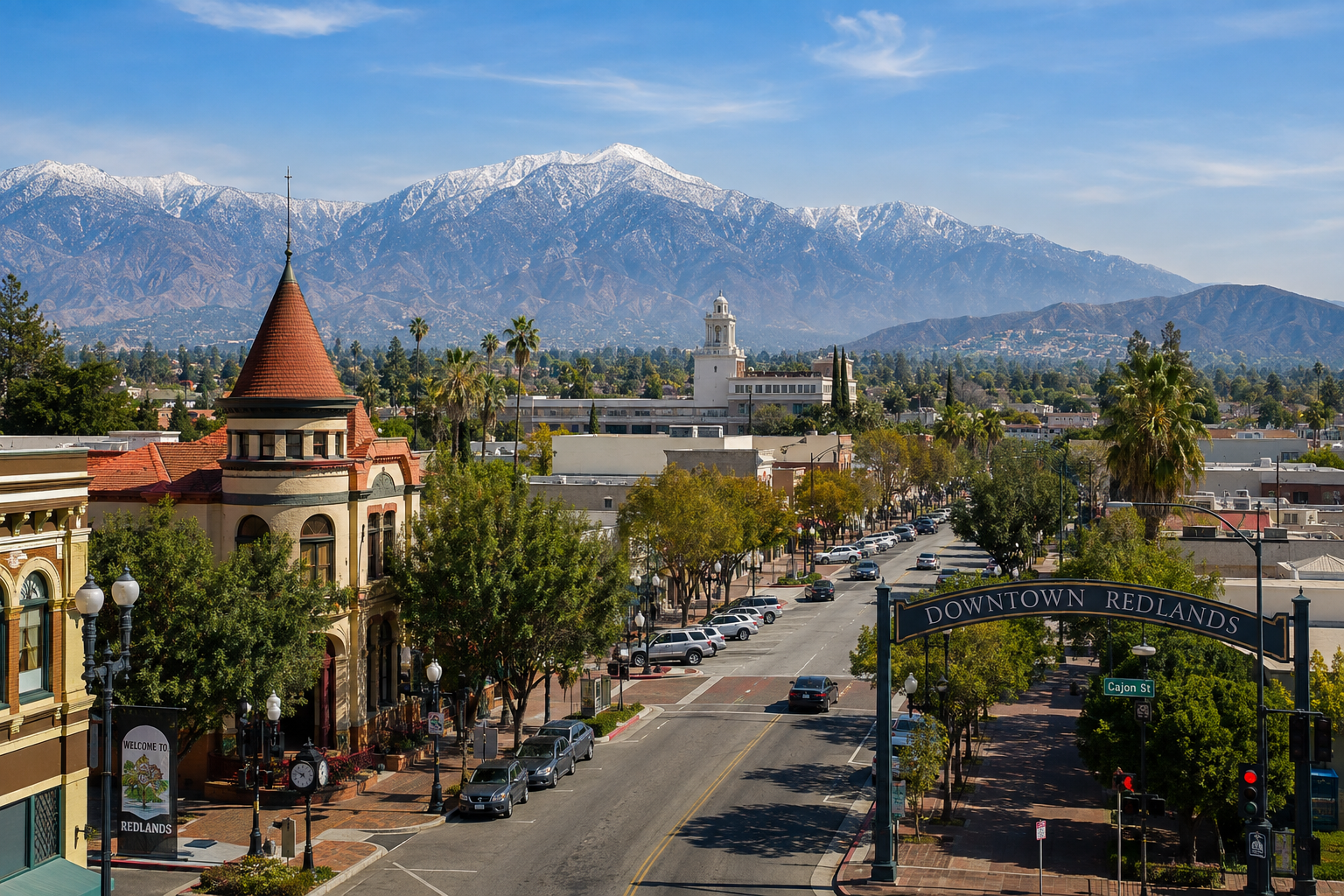
If you are thinking about moving to Redlands, California, you are looking at one of the most distinctive cities in the Inland Empire.
Redlands does not feel like a city that appeared overnight.
You see that immediately in the architecture, mature trees, historic neighborhoods, citrus heritage and Downtown Redlands.
At the same time, this is not simply a historic town frozen in the past.
Redlands has the University of Redlands, passenger rail service, access to major employment centers, newer residential areas, established neighborhoods, parks, trails, restaurants and shopping.
It also sits in an interesting position geographically.
You are next to Loma Linda and its major medical community, west of Yucaipa and the foothills, and connected to the rest of Southern California through Interstate 10.
So if you are considering living in Redlands, CA, here is what I think you should know before deciding whether it is the right fit for you.
Where Is Redlands, California?
Redlands is located in San Bernardino County in Southern California's Inland Empire.
Interstate 10 runs through the city and provides the primary east and west connection toward communities including Loma Linda, San Bernardino, Yucaipa and Beaumont.
That location is one of the reasons I think Redlands works for a wide range of buyers.
Someone working at Loma Linda University Medical Center may consider Redlands.
Someone who wants to live farther east but still needs access toward Ontario or Los Angeles may consider Redlands.
Someone comparing Yucaipa with a city that has a more developed downtown may consider Redlands.
And someone who simply wants an Inland Empire city with its own identity may end up here.
What Is Redlands Known For?
Redlands has several identities layered together.
It is known for its citrus history.
It is known for historic homes and architecture.
It is a university city.
It has a traditional downtown.
It is closely connected with the healthcare economy in neighboring Loma Linda.
And it has neighborhoods that range from historic homes on tree lined streets to conventional suburban communities and newer development.
That combination is important.
There are plenty of Southern California cities where one neighborhood can start to look a lot like the next.
Redlands has areas that are immediately recognizable as Redlands.
The city recognizes eight locally designated historic districts, including Eureka Street, West Highland Avenue, Early Redlands, Normandie Court, East Fern Avenue, Garden Hill, La Verne Street and Smiley Park.
That gives you some idea of how significant preservation and historic character are here.
Downtown Redlands
Downtown is one of the biggest differences between Redlands and many surrounding communities.
You have restaurants, coffee shops, local businesses, historic buildings, community spaces and events concentrated into an actual central district.
That matters if you like being able to park and spend time walking around rather than driving from one shopping center to another.
Downtown also connects several important pieces of Redlands identity.
Smiley Park, the A.K. Smiley Public Library, the Redlands Bowl and the Downtown Redlands train station all sit within this broader central area.
For someone comparing Redlands with Yucaipa, Highland, Beaumont or Loma Linda, Downtown Redlands can be one of the clearest lifestyle differences.
Historic Homes in Redlands
If historic architecture is important to you, Redlands deserves a serious look.
You can find homes representing different periods of Southern California architecture, particularly in the older portions of the city.
That character can be a major selling point.
But buying an older home should also come with realistic expectations.
Depending on the property, buyers may want to pay particular attention to electrical systems, plumbing, roof condition, foundation, windows, HVAC, sewer, previous renovations, permits, historic restrictions where applicable, insurance and energy efficiency.
A beautiful older home can offer character that is almost impossible to reproduce in new construction.
It can also require a different approach to maintenance than a newer suburban home.
That is why I would evaluate the actual property rather than assuming older automatically means better or worse.
South Redlands
South Redlands is one of the areas buyers frequently hear about when they start researching the city.
The appeal can include established neighborhoods, mature landscaping, distinctive architecture and access to some of the city's historic residential areas.
But I would be careful about treating South Redlands as though every street offers the same housing experience.
It does not.
Lot sizes, home ages, architecture, condition and surroundings can change significantly.
That is actually part of what makes exploring Redlands interesting.
You should drive the streets and look at individual properties rather than relying entirely on a neighborhood label.
Living Near the University of Redlands
The University of Redlands is another major part of the city's identity.
Founded in 1907, the university offers a wide variety of undergraduate and graduate programs from its main campus in Redlands.
The neighborhoods surrounding the university have their own feel.
For some buyers, being near the campus is part of the appeal.
For others, the university simply contributes to the culture and activity of the city even if they live elsewhere.
And unlike Loma Linda, where the university and medical system dominate much of the city's identity, Redlands has several different centers of activity.
The university is one of them.
Downtown is another.
The historic residential districts are another.
That makes Redlands feel more varied than its size might suggest.
Redlands and Loma Linda
If you are moving to the area because of Loma Linda University Health, I would absolutely compare Redlands with Loma Linda before purchasing.
They are neighboring cities, but the lifestyle can feel quite different.
Loma Linda is heavily influenced by healthcare, the university and the Seventh Day Adventist community.
Redlands has a broader traditional city environment with Downtown Redlands, historic neighborhoods, the University of Redlands and a larger dining and shopping scene.
Someone working at Loma Linda University Medical Center may decide that living directly in Loma Linda makes the most sense.
Someone else may prefer the housing or lifestyle in Redlands and accept the commute.
There is no universal answer.
The important thing is realizing you have both options.
Redlands and Yucaipa
This is another comparison I expect buyers to make frequently.
Redlands and Yucaipa are close geographically, but they offer different residential experiences.
Yucaipa can appeal to buyers looking for foothill living, larger lots, RV parking, newer planned communities or a more suburban and semi rural environment.
Redlands can appeal to buyers who prioritize a traditional downtown, historic architecture, mature neighborhoods, university influence and closer proximity to Loma Linda.
The right choice depends on what you value.
If I were relocating to the area and unfamiliar with both cities, I would spend a day exploring each before making assumptions based on listing photos.
They feel different in person.
What Types of Homes Can You Find in Redlands?
One reason Redlands works for a broad range of buyers is the variety of housing.
Depending on current inventory, you may find several different types of properties.
Historic Homes
These are among the properties that give Redlands its distinctive identity.
They can offer architectural details, mature neighborhoods and a sense of history that newer developments cannot easily duplicate.
Established Single Family Homes
A large portion of Redlands consists of traditional residential neighborhoods with homes built across many different decades.
Condos and Townhomes
Buyers looking for attached housing or a potentially lower maintenance option can find condos and townhomes in the city as well.
Newer Homes
Redlands is not exclusively older housing.
There are newer residential communities and newer individual homes, giving buyers options if they prefer more contemporary construction.
Larger Properties
Depending on the area and current inventory, buyers can also encounter larger lots and properties that feel substantially different from conventional subdivision homes.
This variety is exactly why a citywide median home price does not tell the whole story.
Is Redlands Walkable?
Parts of it can be.
Downtown is the obvious example.
If you live close enough to Downtown Redlands, restaurants, shops, community spaces and transit may be accessible without getting in the car for every single trip.
But Redlands as a whole is still a Southern California city.
Your experience will depend heavily on where your home is located.
Someone living near downtown may have a completely different walking routine from someone living farther south or near the outer portions of the city.
So if walkability matters to you, evaluate it at the property level.
Do not rely on a citywide generalization.
Passenger Rail Service in Redlands
Passenger rail has become an increasingly important part of the Redlands transportation picture.
Metrolink's Arrow service connects Redlands and San Bernardino along a nine mile corridor.
Redlands has stations serving Esri, Downtown Redlands and the University of Redlands.
Connections through San Bernardino can provide access to the broader Metrolink system.
That does not mean every Redlands resident can suddenly give up their car.
But it does give the city a transportation option that many Inland Empire communities do not have.
If you are considering a property near one of the stations, I would look at the current schedule and determine whether the service actually works for your commute.
Parks and Outdoor Recreation
Redlands also has a substantial outdoor side.
Depending on where you are in the city, you will find parks, trails and access toward the surrounding foothill environment.
The Orange Blossom Trail is one example of the city's trail network and provides another recreational option for residents.
You also have established parks and recreational areas throughout Redlands.
For buyers, this is another reason to think beyond the house itself.
If you run, walk, cycle or spend a lot of time outside, proximity to a trail or park may matter more to you than another bedroom or a slightly larger lot.
Shopping and Dining in Redlands
This is one of Redlands' stronger lifestyle advantages compared with some nearby communities.
You have Downtown Redlands for local restaurants, coffee and businesses, plus larger commercial areas elsewhere in the city.
And because Redlands serves as a destination for surrounding communities, your dining options are not limited to a handful of neighborhood restaurants.
If you live in Loma Linda or Yucaipa, there is a good chance you will end up coming into Redlands for certain restaurants, shopping or events anyway.
Living here puts those amenities closer.
What Is the Weather Like in Redlands?
Redlands has the warm, dry climate you would expect from the Inland Empire.
Summers can get hot.
That is something buyers relocating from coastal Southern California should understand.
A summer afternoon in Redlands is not going to feel like Newport Beach.
Air conditioning, energy efficiency, shade, window exposure and landscaping can all affect how a home feels and what it costs to operate.
Winters are generally much milder, and the surrounding mountains can provide a completely different seasonal backdrop.
For buyers coming from outside Southern California, I would pay attention to how the home itself handles the climate, not just the average temperature.
Commuting From Redlands
Redlands sits directly along Interstate 10, which makes east and west travel relatively straightforward geographically.
But geographically straightforward does not mean traffic free.
If you are commuting west toward Ontario, Rancho Cucamonga, Los Angeles or Orange County, your departure time can make an enormous difference.
If you work in Loma Linda, San Bernardino or another nearby Inland Empire employment center, the commute may be much more manageable depending on your exact destination.
Passenger rail also creates another option for certain trips between Redlands and San Bernardino, with broader Metrolink connections available from there.
My recommendation is the same one I give people considering Loma Linda.
Test your actual commute.
Drive it at the time you would normally leave for work.
Do not judge it from a map on Sunday afternoon.
Buying an Older Home in Redlands
This deserves its own section because older housing is part of the appeal here.
When buyers walk into a Redlands home with original architecture, mature trees and a beautiful established street, it is easy to fall in love quickly.
That is fine.
Just make sure the inspection process catches up with the emotion.
Older properties may have been modified multiple times over decades.
You want to understand what has been updated, what has not, and what may require attention.
Depending on the property, that could mean evaluating electrical systems, plumbing, roof, foundation, HVAC, sewer, drainage, windows and previous additions or renovations.
And if you are purchasing within a designated historic district, understand whether any applicable preservation requirements could affect future exterior changes.
Does Redlands Have Newer Homes?
Yes.
This is another misconception worth clearing up.
Redlands has a strong historic identity, but buying here does not mean you have to purchase a century old house.
There are newer homes and more conventional suburban communities throughout portions of the city.
For buyers, that creates an interesting choice.
Do you want historic character and an established neighborhood?
Or do you prefer newer construction, modern layouts and potentially different maintenance considerations?
Some buyers know immediately.
Others need to tour both before they realize what they actually prefer.
Is Redlands Expensive?
The answer depends on what you are comparing it with.
Compared with some Inland Empire communities, certain Redlands neighborhoods and properties can command a premium.
Compared with coastal Southern California, the conversation may look completely different.
But citywide averages can be misleading here because Redlands has such a wide range of housing.
A condo, historic home, conventional suburban property and larger South Redlands residence are not interchangeable.
If you are trying to determine whether you can afford Redlands, I would rather look at current homes in your actual price range than give you one citywide number.
That tells you what your money buys today.
What Should Buyers Know About Property Taxes?
California property taxes generally begin with the statewide Proposition 13 framework, but the actual tax bill can include additional voter approved debt and property specific assessments.
That means two similarly priced Redlands homes do not necessarily have identical tax bills.
Do not simply look at what the current owner pays.
A change in ownership can also trigger reassessment.
When evaluating a property, look at the actual tax information associated with that address and estimate what your ownership costs may be after purchase.
What About Homeowners Insurance?
Insurance is another expense I would investigate early.
The exact cost and availability depend on the property, insurer and location.
Homes closer to foothill areas or properties with characteristics that affect underwriting may have a different insurance situation from homes elsewhere in Redlands.
Do not wait until the last minute to discover what the insurance looks like.
Once you are seriously considering a property, get a quote for that specific address.
Pros of Living in Redlands
For me, one of the biggest advantages is that Redlands has an identity.
You have a real downtown.
You have historic architecture.
You have the University of Redlands.
You have mature neighborhoods.
You have parks and trails.
You have passenger rail service.
You are close to Loma Linda's medical community.
And you still have relatively convenient access to Yucaipa, Highland, San Bernardino and the rest of the eastern Inland Empire.
There is a lot packed into one city.
Things to Consider Before Moving to Redlands
The same features that attract one buyer may not matter to another.
If you want a huge lot and RV parking, you may find more options that fit your priorities in certain parts of Yucaipa or other surrounding communities.
If you are commuting deep into Los Angeles every day, the distance is something you need to experience before buying.
If you are purchasing a historic property, you need to be comfortable with the realities of owning an older home.
If you are buying near Downtown Redlands or the university, understand the activity around the property at different times of day.
And if you are moving here because someone told you Redlands is the best city in the Inland Empire, do not buy based on somebody else's priorities.
Come see it yourself.
Frequently Asked Questions About Living in Redlands, CA
Is Redlands a Good Place to Live?
Redlands can be a strong fit for buyers who value historic character, a traditional downtown, access to restaurants and shopping, the University of Redlands, parks and trails, proximity to Loma Linda and connections to the broader Inland Empire.
Whether it is right for you depends on your budget, commute, preferred housing type and lifestyle.
What Is Redlands, California Known For?
Redlands is known for its citrus heritage, historic architecture, Downtown Redlands, the University of Redlands and established residential neighborhoods.
The city also has several locally designated historic districts.
Does Redlands Have a Downtown?
Yes.
Downtown Redlands is an established central district with restaurants, businesses, historic buildings, community spaces and passenger rail access.
It is one of the features that distinguishes Redlands from several nearby Inland Empire communities.
Does Redlands Have Train Service?
Yes.
Metrolink's Arrow service connects Redlands with San Bernardino, where riders can access connections within the broader regional transit system.
Always check the current schedule if rail access will be an important part of your commute.
Is Redlands Close to Loma Linda?
Yes.
Redlands borders Loma Linda, which makes it a common housing option for people working or studying within the Loma Linda University Health system.
Is Redlands Close to Yucaipa?
Yes.
Redlands sits west of Yucaipa along the Interstate 10 corridor.
The two cities are close enough that buyers relocating to the eastern Inland Empire may reasonably compare both.
Does Redlands Have Historic Homes?
Yes.
Historic architecture is an important part of Redlands' identity.
The city maintains a historic preservation program and recognizes multiple locally designated historic districts.
Is There a University in Redlands?
Yes.
The University of Redlands was founded in 1907 and remains an important educational and cultural institution within the city.
Can You Live in Redlands and Work in Loma Linda?
Yes.
Because the cities border one another, Redlands is one of the communities buyers may consider when relocating for employment or education at Loma Linda University Health.
Your actual commute depends on the locations of your home and workplace and the time you travel.
Are There New Homes in Redlands?
Yes.
Although Redlands is well known for historic and established neighborhoods, buyers can also find newer homes and more contemporary residential communities depending on current inventory.
Should You Move to Redlands, California?
If you are considering moving to Redlands, I would spend more than an hour driving around.
Start Downtown.
Walk State Street and the surrounding blocks.
Drive through some of the established residential streets.
Visit the University of Redlands area.
Head south and see how the neighborhoods change.
Look at newer communities.
Then drive into neighboring Loma Linda and Yucaipa.
That last part is important.
Do not decide whether Redlands is right for you without understanding what your other nearby options look like.
You may realize you love Redlands because of its downtown and historic character.
You may decide you want to be closer to Loma Linda University.
You may discover that Yucaipa's foothill environment and larger properties fit you better.
That is exactly why local knowledge matters.
You are not simply choosing a house.
You are choosing the community you will experience every day.
Redlands offers something that is increasingly difficult to manufacture in Southern California.
History.
Mature neighborhoods.
A recognizable downtown.
A university.
Parks and trails.
Transportation connections.
And a residential identity that has developed over generations.
If you are considering buying or selling a home in Redlands, I would be happy to help you compare properties, neighborhoods and surrounding communities so you can make the decision with a better understanding of the local market.
Nick Ondatje | REALTOR®
Mainstreet Realtors
CA DRE 01401990
909-437-0132
Check out this article next